
Website creation with HubSpot CMS: A Guide with Tips
The most efficient way to create a website in HubSpot is to follow a clear sequence: first, set up the domain; then, select a suitable theme; build...
4 min read
Dorothea Benner
|
Jul 02, 2026
Today, people looking for solutions are increasingly turning to AI-based search systems such as ChatGPT, Perplexity, or Google Gemini. In this “zero-click” research process, initial answers, comparisons, and provider recommendations appear directly within the AI—even before potential customers visit a website. This creates a new visibility gap for B2B companies: Those who do not appear in these answers are hardly noticed during the early stages of the purchasing decision.
This is exactly where AEO comes in. AEO (Answer Engine Optimization) is the further development of SEO in the context of AI-powered answers. The focus is on preparing and structuring content in such a way that AI-based response systems can reliably understand it, classify it as a trustworthy source, and cite it in their responses—or place the company’s brand in curated lists of top providers.
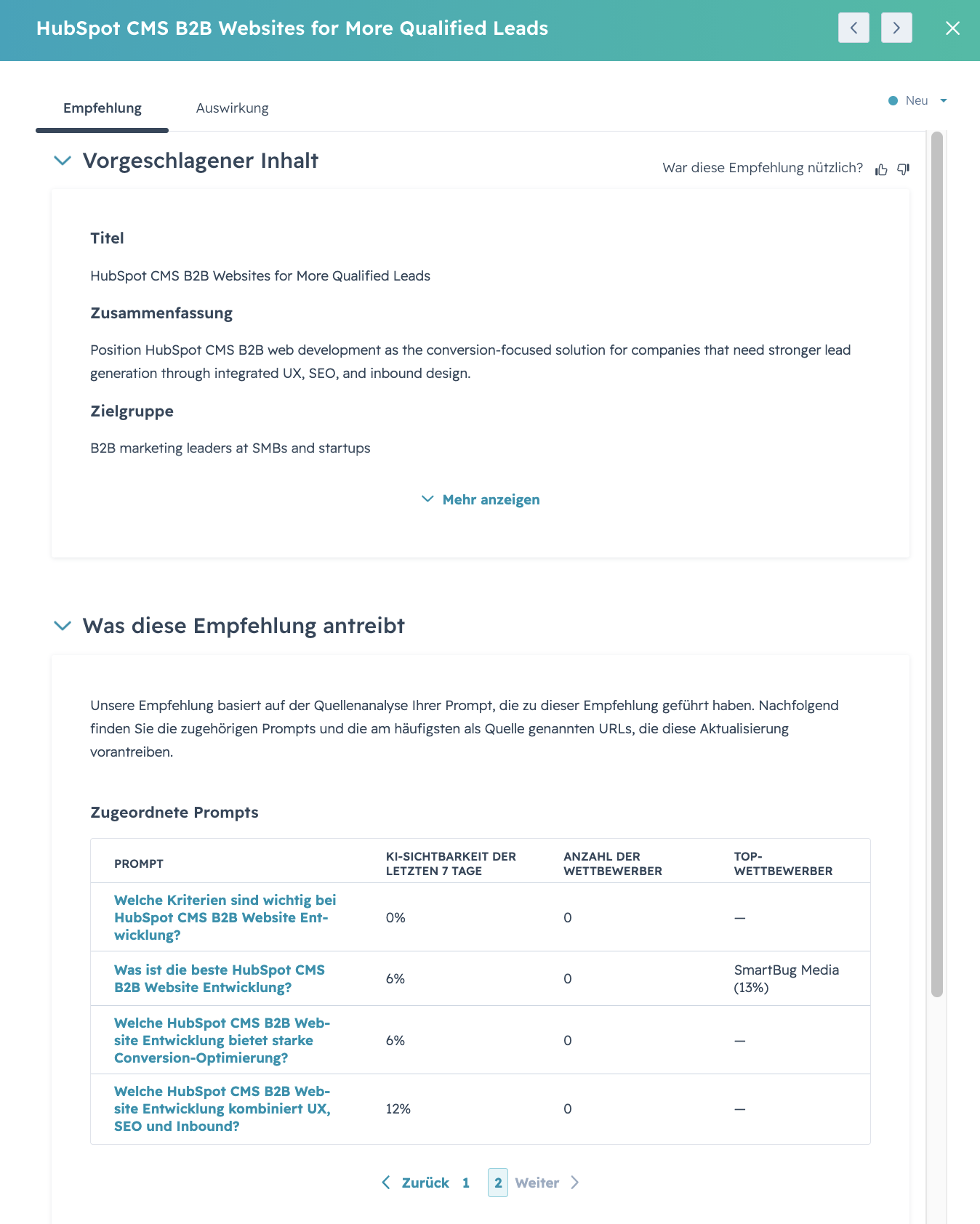
With HubSpot’s AEO tool, this visibility becomes more tangible. Companies can track which questions their content appears in AI responses, which competitors are favored, and where content gaps still exist. They can not only strategically plan this process but also transparently track and concretely measure it—from the initial content idea through creation and publication to actual visibility in AI responses.
Content Overview:
HubSpot’s AEO Tool is the first tool to link CRM customer data and suggest relevant prompts based on that data. The main purpose of this software is to help companies appear in relevant search results with their own brand and be perceived as a trusted source through their own content.
This isn’t just about writing content; it involves two key aspects: the structure and quality of the content, as well as your brand’s visibility in the digital landscape. Together, these two factors determine whether your content appears in AI-generated responses or not.
AI has fundamentally changed search behavior. More and more people are using AI to conduct precise searches with specific questions and expect a concise answer. Brands that do not appear in these answers or in the curated list lose visibility and potential leads right from the start—in the early, crucial stages of the customer journey.
For companies, AEO is therefore a crucial strategic approach to:
This is a significant advantage, especially for services that require explanation. Those who communicate in a way that is understandable, concise, and thematically strong increase the likelihood of being cited by AI systems as a relevant source.
HubSpot helps companies systematically build their AEO. The focus is not only on individual content types, but also on relevant prompts, citations, domains, recommendations, and competitor comparisons.
This is particularly helpful because it reveals not only “whether” a brand is visible, but also “why.” This makes it easy to quickly determine which content is already performing well, where there are content gaps, and which formats or topics should be specifically expanded.
To make it easier for answer engines to index and cite content, it should be clearly structured, concisely written, and, above all, easy to scan. Content that directly answers questions and presents information in a clear, organized manner is particularly effective.
The following work especially well for AEO:
Conversely, if content consists primarily of long blocks of general text, the likelihood that individual statements will be clearly extracted and incorporated into AI responses decreases.
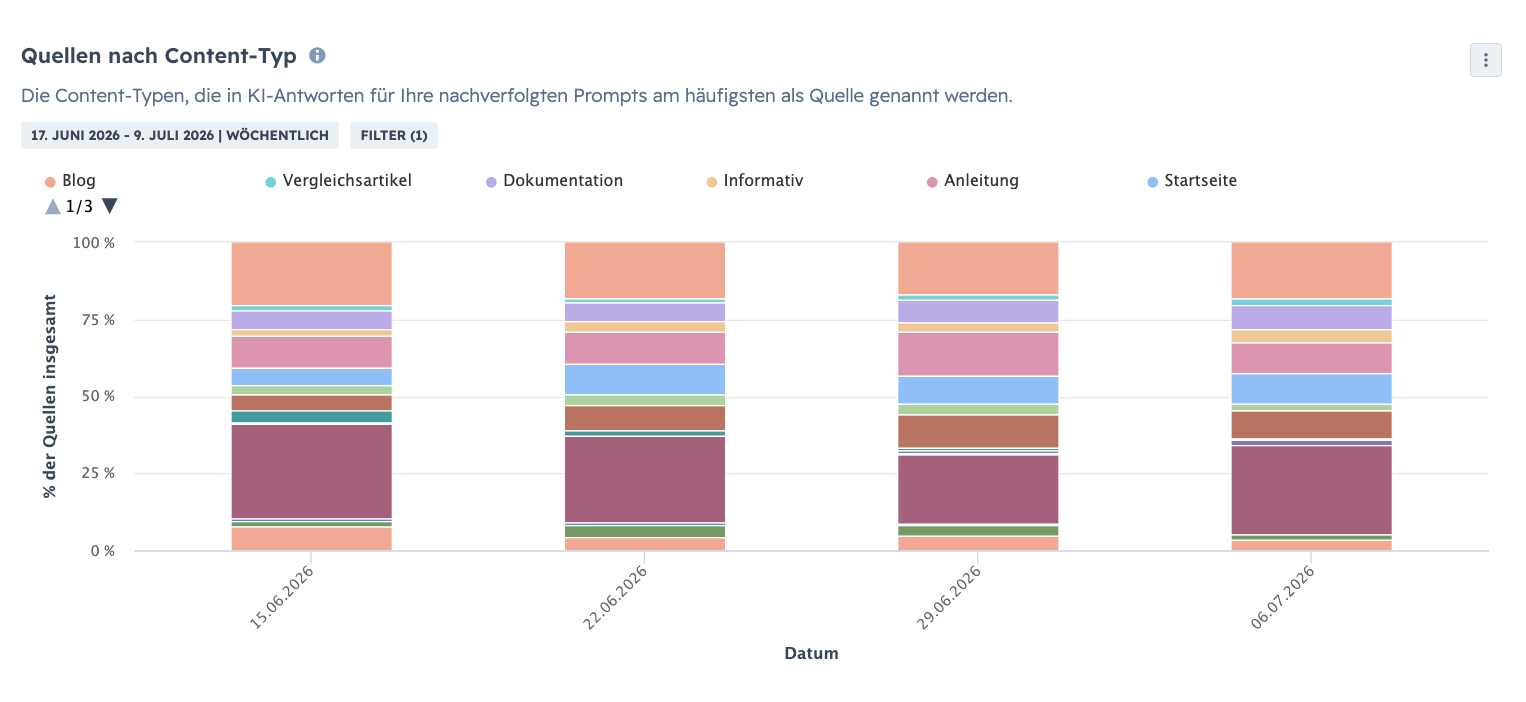
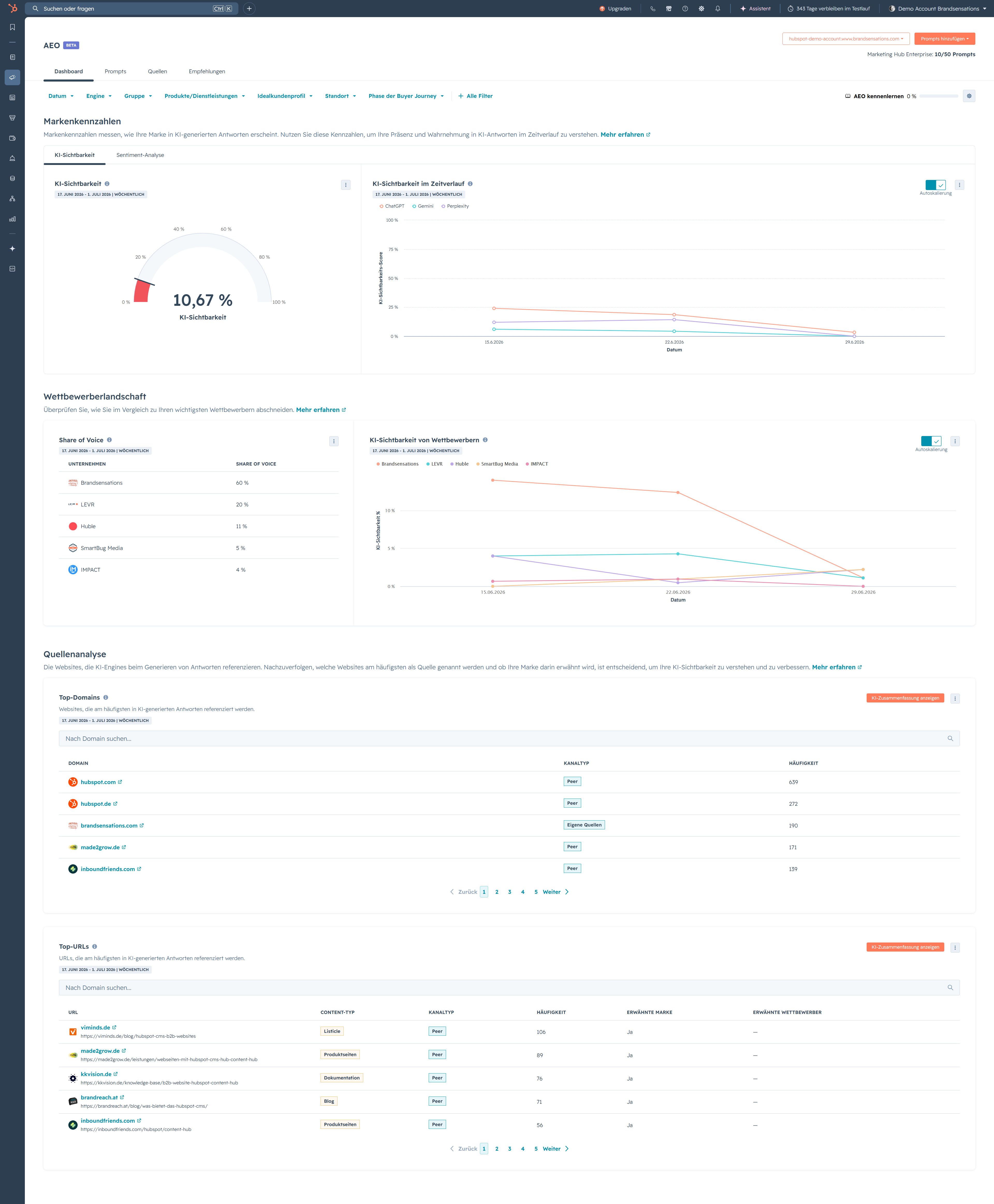
The AEO dashboard consolidates all relevant and critical metrics related to AI visibility in one central location. This allows you to track your brand’s performance in AI-powered online searches in detail, better understand the underlying causes, and optimize visibility in a targeted manner.
The AEO dashboard consolidates the following key metrics, among others:
This dashboard is essential, especially for teams that are strategically developing their content. It not only shows that content has been published, but more importantly, “where, how often, and in what context” it appears in AI responses.
The profound added value of AEO in HubSpot emerges when the linked AI visibility from AEO is integrated into marketing analytics suites and analyzed alongside the signals from the AEO dashboard. The dashboard shows “where” a brand is visible, in which prompts it appears, and which sources contribute to that visibility.
The analytics suites further evaluate “which content promises the greatest strategic success” and make AI visibility measurable, thoroughly analyzable, and optimizable in relation to your business results. This creates a direct link between your AI visibility, your business success, and the targeted prioritization, creation, and optimization of content.
AEO with HubSpot combines content optimization with measurability. This is precisely where its unique value lies: Companies can not only optimize their content specifically for AI searches but also transparently track and evaluate the resulting visibility.
The key benefits at a glance:
AEO with HubSpot helps companies make content more discoverable, understandable, and citable for AI-powered searches. The key lies not only in optimizing individual pieces of text, but also in connecting content, visibility, and analytics.
Analytics suites and the AEO dashboard play a central role in this process. Together, they show not only whether a piece of content has been published, but also whether it is actually gaining visibility, being cited, and making an impact in the relevant subject area.
This is precisely what transforms a single blog post into a strategic content building block for greater digital presence.
Companies that want to know whether their existing content is already AEO-optimized and where the greatest opportunities for increased visibility in AI searches lie can use HubSpot’s AEO Tool to gain a structured view of their content, prompt data, citation patterns, and topic gaps.
Image source: AdobeStock © lorenzophotoprojects 365496110
Share this article:
The most efficient way to create a website in HubSpot is to follow a clear sequence: first, set up the domain; then, select a suitable theme; build...
What's better than building a website page quickly? Building one that is also optimized to improve performance, reduce page loading times, and leave...
You work with HubSpot and already use the HubSpot CMS from the Content Hub for your website. You may be familiar with the HubSpot HubDB...